You are about to spend real money on AI implementation. You have talked to two or three providers already. Every one of them sounded credible. Every demo looked impressive. And you could not tell the difference between any of them.
That is not a vendor problem. That is a preparation problem.
The most valuable work in AI implementation happens before you talk to a single provider. It costs nothing. It requires no outside help. And the company that does it arrives at the first conversation with a completely different lens.
The Wrong Readiness Question
The AI readiness industry has a standard playbook. Assess six pillars: strategy, data, infrastructure, governance, talent, culture. Score your maturity. Identify gaps. Build a roadmap.
Every one of those assessments asks the same question: are your systems ready for AI?
Not one of them asks the question that actually determines whether the AI will produce anything worth using: is the substance of your business captured anywhere that AI can reach it?
Here is why that matters. The reason most AI output sounds generic has nothing to do with the technology. It has to do with what the AI was given to work with. There are two ways this goes wrong, and almost every company is living with one of them.
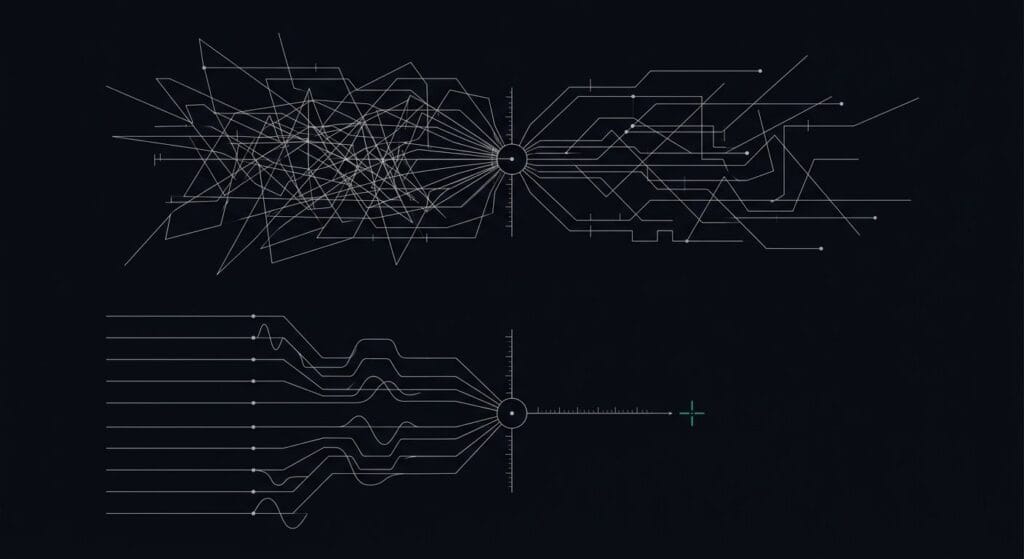
The first is the empty foundation. The AI was never given anything specific to your business, so it produces what it has: the internet’s average. The statistical middle of everything ever written, dressed up as your strategy, your voice, your methodology.
The second is the blended foundation. Someone fed the AI everything they could find. Proven frameworks and unproven ones. Authoritative sources and amateur ones. All mixed together with no curation. The output sounds more sophisticated. It is grounded in nothing specific, because nobody filtered for what actually works.
Both failures start in the same place. The substance of the business was never captured, structured, or made available in a form that AI could use. Readiness assessments will never catch this. They evaluate whether your infrastructure can run AI. They do not evaluate whether you have given AI anything real to run on.
That is the gap this audit fills.
Three Kinds of Business Knowledge
Before you can audit what you have, you need a vocabulary for what to look for.
The first layer is the documented version. Your brand guide. Your website. Your sales deck. The templates your team was told to follow. This is what every provider will find in the first week. It is also what generic AI already has access to. AI trained on this layer produces output that sounds like a polished version of your website. Which is exactly what most companies are already getting.
The second layer is where the real value lives. This is the undocumented methodology your best people actually run on. Your top salesperson’s talk track. Not the script in the CRM. The actual language she uses in the third email that gets the meeting. The decision logic your operations manager calls “experience.” The way your founder explains the company when there is no slide deck in front of her.
This layer exists in every company. Almost none of it is written down. Knowledge management research has a name for it: tacit knowledge. The practical, action-oriented expertise that people develop through years of doing the work. Studies consistently find that roughly two thirds of the work-related information employees use comes through informal channels, not formal documentation. The documented version of your company is the minority of what actually drives the business.
The third layer is the deeply personal expertise that may never be fully capturable. The instinct a veteran account manager has for when a deal is about to go sideways. The pattern recognition your CEO uses to read a room. You will not capture all of this. But you need to know it exists, because some of it can be structured and some of it cannot. Knowing the difference matters.
Most companies have only the first layer available. Most AI is built on only the first layer. That is why the output sounds like the internet. The foundation has nothing specific in it.
The Audit
This is the work. No consultant. No software. No budget. Just honesty and a few hours.
Where does your real methodology live?
Not the brand guide. The actual methodology. The way your best salesperson qualifies a prospect. The way your operations team handles the edge case that comes up every quarter. The way your best client-facing person defuses the objection that kills most deals.
Is any of that written down? Is it in a document someone could hand to a new hire and say “this is how we actually work here”? Or does it live entirely in the heads of three people who have been with the company since the beginning?
If it is not documented, it is not available to any AI system. Full stop. The most advanced model in the world cannot use methodology that exists only in someone’s memory.
What is documented versus what is tribal?
Walk through each department. Sales. Marketing. Operations. Client delivery. For each one, ask: if the best person in this department left tomorrow, what would we lose?
Their knowledge. The specific way they do the work that produces the results.
Every company has people like this. The person everyone calls when the situation gets complicated. The person whose emails always get responses. The person who somehow closes deals nobody else can close. Their knowledge is tribal. It has never been captured. It walks out the door with them. And no AI implementation will ever touch it unless someone structures it first.
If you have departments where one departure would create a knowledge vacuum, that is not just an HR risk. That is the single clearest indicator that your AI will never reach the layer where the real value lives.
What emails actually work versus what templates exist?
Every company has templates. Most of them sit unused in a shared drive while one person on the team writes emails that get responses every time. The phrasing is different. The structure is different. The timing is different. The results are different.
Which version did your AI learn from?
If you do not know, the answer is the templates. Because the templates are documented and the real approach is not. Your AI is trained on the thing that does not work while the thing that does work lives in one person’s sent folder.
That is the gap. Not a technology gap. A knowledge gap. And it exists in every department, for every process, across every company that has never formally captured how its best people actually operate.
What is your current AI actually built on?
This is the question most companies cannot answer. They know they use AI tools. They know the output is not great. They know their team rewrites most of what the AI produces. They have never asked what the AI actually has access to.
If the answer is “our website, our brand guide, and whatever the model already knows from the internet,” then your AI is built on the first layer. The documented surface. The same surface every competitor’s AI also has access to. The same surface that produces the same generic output across every company using the same tools.
That is not an AI failure. It is a foundation failure. And if a provider layers better AI on top of that same empty foundation, or blends in every methodology they can find without filtering for what actually works, the output will still be generic. It will just be more confidently generic.
The question is not whether you need better AI. The question is whether the substance of your business has ever been captured in a form that any AI could use.
What This Changes About the First Conversation
A company that has done this audit walks into the first provider conversation knowing something specific. They know where their real methodology lives. They know what is documented and what is tribal. They know what would disappear if one person left. They know what their current AI is actually built on and what it is missing.
That changes everything about the conversation.
They are not sitting through demos wondering which one looks more impressive. They are asking: does this provider’s process reach the second layer? Do they have a method for capturing the undocumented methodology? Do they have a way to tell the difference between the templates nobody follows and the emails that actually work? Or do they collect the surface and call it discovery?
The provider who only collects your brand guide, your website, and a few call transcripts is collecting the first layer. You already know what AI built on that layer produces. You have been living with it.
The provider whose process reaches the undocumented methodology, structures it, and builds it into the AI’s foundation is doing fundamentally different work. You can only recognize that difference if you have mapped the territory yourself.
This audit takes a few hours. It costs nothing. And it is the single highest-leverage thing you can do before spending a dollar on AI implementation.
Do the work. Then evaluate providers. The order matters.