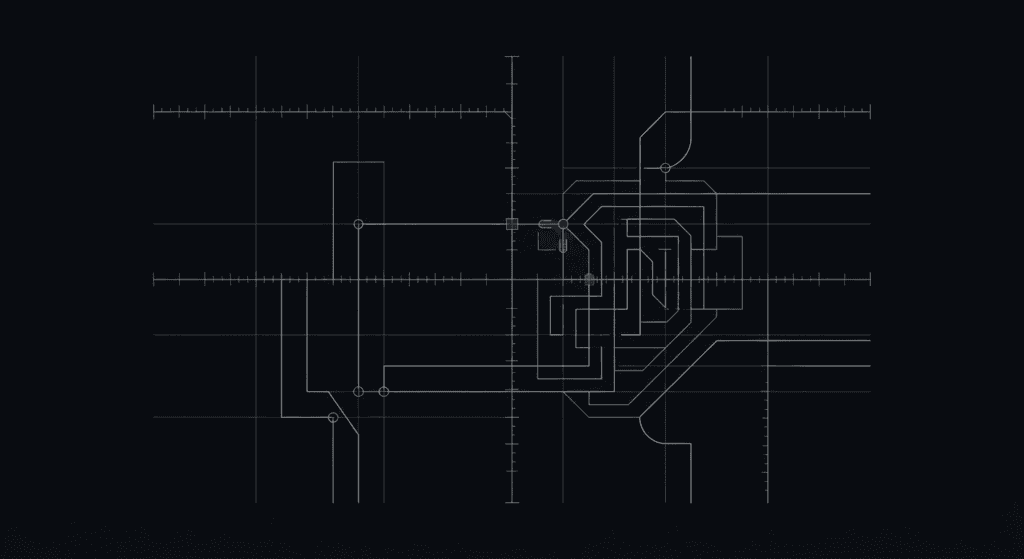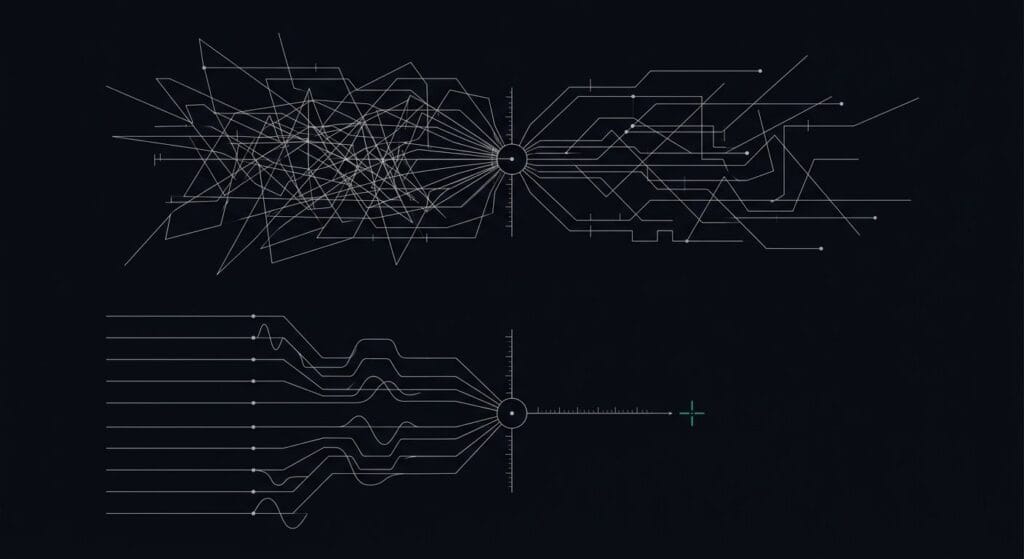
The AI output reads fine. The sentences are clean. The structure holds. If you scan it quickly, nothing jumps out as wrong.
And it could belong to any company in your industry.
Strip the logo off the top. Remove your company name. Hand it to someone who knows your market and ask them to guess whose content it is. They will not guess yours. They will not guess anyone’s. The output was not built on anything specific to your business. It was built on the internet’s statistical average of your industry, dressed up as your voice.
Most people blame the AI. The model is not the problem.
The discovery process that fed it is the problem. What the provider learned about your business before building the system determines everything downstream. The depth of that discovery is the single best predictor of whether the AI will carry the weight of your business or float on the surface of your category.
Every provider says they have a discovery process. The question is not whether they have one. The question is what it actually captures.
What Most Providers Call Discovery
The consulting industry has used the word “discovery” for decades. It describes the knowledge transfer process when a provider begins working with a new client: the review of existing documents, the stakeholder interviews, the data analysis, the questionnaire.
This is legitimate work. Nobody is faking it. The standard discovery toolkit captures real information: your website, your brand guide, your pitch deck, your documented processes, what your leadership team describes on a call.
Some providers are thorough about it. Some compress the entire process into a single 45-minute call. But even the thorough ones typically end up in the same place: a collection of spreadsheets, raw data, and the subjective impressions of a few conversations.
Here is the thing. In traditional consulting, this level of discovery can still work. A human consultant interprets the gaps. They fill in context from their own experience. They adjust recommendations in real time based on what they observe. The human is the buffer between incomplete information and the final deliverable.
In AI implementation, there is no buffer.
The system knows exactly what you put into it. It does not interpret gaps. It does not fill in context from experience. It does not sense that something is missing and adjust. What the discovery process misses, the AI will never recover.
The output is a direct expression of the input. And for most providers, the input is the documented version of your business.
That is not discovery. That is data collection. And data collection captures the layer of your business that is least unique and most available to generic AI already.
The Three Layers of Business Knowledge
Every business operates on three layers of knowledge. Most providers touch only the first one.
Layer one is the documented version. This is everything that exists in writing. The website. The brand guide. The employee handbook. The sales deck. The CRM fields. The templates. The process documents someone created three years ago that nobody has updated since.
This layer is real. It contains useful information. But it is also the most generic layer of any business. Documented materials tend to converge on industry norms. And it is the layer that generic AI already has access to.
If you paste your website copy into ChatGPT, the model already knows what is there. Building an AI system on your documented layer alone produces output built on information the AI could have found without you.
Layer two is the undocumented methodology. This is what your best people actually do. Not what the handbook says. What happens in practice.
Your best salesperson closes 40% of qualified deals. Your average rep closes 18%. The gap is not talent. It is methodology. She follows a framework she has never written down. She reads a room in a way she cannot fully explain. She knows when to push and when to pause, and if you ask her how she knows, she will say something like “you just feel it.”
That is not a feeling. That is a decision framework operating below the level of conscious articulation.
Your operations manager follows decision logic he calls “experience.” Your brand voice lives in your best client emails, not in the brand guide. Your most effective marketing campaigns were shaped by instincts that were never documented into systems.
The research on this is not subtle. Roughly 80% of processes in most organizations remain undocumented. They exist only in people’s heads. They transfer inconsistently and without control, passed along by word of mouth rather than formal systems.
The people who hold this knowledge often do not realize they hold it. It has become so embedded in their daily practice that it feels like common sense rather than expertise.
This is where competitive advantage actually lives. And it is the layer that most AI providers never reach.
Layer three is integration. This is where what exists gets mapped against proven frameworks that fill the structural gaps.
Not every business has a complete methodology, even at the undocumented level. Some instincts are right but unstructured. Some processes work but cannot explain why. Some approaches succeed by accident and would break under different conditions.
Layer three identifies the gaps and fills them with frameworks grounded in authoritative research, so the AI is not just reflecting what the business already knows. It is extending it with what the business needs.
Almost no provider reaches layer three. The ones who reach layer two are rare enough.
Why Layer Two Resists Extraction
This is not a failure of effort. It is a structural problem with how knowledge works.
Knowledge management researchers have studied this distinction for decades. Explicit knowledge is what can be written down, shared in documents, and transferred through formal channels. Tacit knowledge is what people know from experience but cannot easily articulate.
The most influential framework in the field, developed by Nonaka and Takeuchi, maps how organizations create knowledge by converting between these two types. The hardest conversion is tacit to explicit: taking what someone knows in practice and making it available in a form others can use.
Michael Polanyi, the philosopher who first formalized the concept, put it simply: we can know more than we can tell.
Your best salesperson cannot fully explain why she closes at a higher rate. She can describe some of what she does. But the timing, the way she reads resistance, the phrasing she reaches for under pressure, the instinct for when a deal is real and when it is theater: that knowledge is embedded in practice.
It does not surface through a questionnaire. It does not emerge in a 45-minute call. It resists the standard discovery toolkit because the standard toolkit was designed to capture what people can already articulate. Layer two, by definition, is what they cannot.
Western business culture has a bias toward explicit knowledge. If it is not documented, it does not exist in the system. But the documented layer is the least differentiated part of any business. The act of documentation tends to smooth out the distinctive edges that make a business actually work.
When a provider reviews your website, your brand guide, and your process documents, they are working with roughly 20% of what makes your business run. The other 80% requires a discovery process specifically designed to surface what people know but have never written down.
Most providers do not have that process. Not because they are lazy. Because it requires a fundamentally different approach than data collection, and most providers have never built one.
What Happens When AI Is Built on Layer One Alone
The failure data tells a consistent story.
MIT’s research tracked what they call a “funnel of failure”: 80% of organizations explore AI, 60% evaluate solutions, 20% launch pilots, and 5% reach production. The 95% failure rate is not a technology problem. The core issue, according to the researchers, is the learning gap between the tools and the organizations deploying them.
Generic AI tools work for individuals because of their flexibility. They fail in enterprise deployment because they do not learn from or adapt to the specific workflows, knowledge, and operations of the business.
The pilot-to-production gap is where the discovery failure becomes visible. Pilots succeed because they operate in controlled conditions: curated data, limited scope, expert oversight, a small group of users tolerant of imperfect output. None of those conditions exist in production.
In production, the AI encounters the full reality of enterprise knowledge: unstructured information scattered across hundreds of sources, constantly evolving content with no update mechanism, and no single source of truth for most topics. If the discovery process did not capture the real knowledge that drives the business, production is where that gap shows up.
Over half of organizations report their data is not AI-ready. But “AI-ready” is not just a data hygiene problem. It is a discovery problem. If the provider never captured the knowledge that makes your business distinct, the cleanest data pipeline in the world will still produce generic output.
And here is what makes this problem invisible. The output does not look like failure. It sounds fine. The sentences make sense. The structure holds. The problem shows up over time.
You tweak a sentence. You adjust the tone. You rewrite the opening. Each individual change feels minor, but the changes never stop. The AI produces the internet’s statistical average, and you spend your time editing it toward something that sounds like your business.
That editing tax is the direct cost of shallow discovery. You are paying your team to do the work the provider’s discovery process should have done.
The AI is not failing because it lacks capability. It is failing because it was told too much about everything and not enough about you. Without a center of gravity, the system defaults to averaging. The result sounds confident and means nothing specific.
How to Recognize Which Layer a Provider Reaches
The output is the diagnostic.
You do not need a technical evaluation to know whether discovery went deep. You need to read what the AI produces and ask one question: could this belong to any company in my industry, or does it sound like mine?
Signs the provider stopped at layer one. They reviewed your website, your brand guide, and your documented processes. They asked you to describe your business on a call. They sent a questionnaire. Their deliverable reflects information you could have given a freelancer in an afternoon. The output reads like a polished version of your own marketing materials, smoothed of the rough edges that actually made them distinctive.
Signs the provider reached layer two. They talked to your best performers, not just your leadership. They asked questions designed to surface what people do, not just what the documentation says people do. They identified gaps between the official process and the actual process. They captured the voice that lives in your strongest client interactions but has never appeared in a style guide. Their deliverable contains things you recognize as true but have never seen written down.
Signs the provider reached layer three. They did not just mirror your business back to you. They identified where your methodology has structural gaps and filled them with frameworks grounded in proven research. The AI output is not a copy of what your best people already do. It is an extension of it, built on something your team can grow with.
The depth of discovery is observable in the output. Every time.
The Foundation Determines the Output
The AI output that sounds generic is not an AI problem. It is a foundation problem. And the foundation has two failure modes, not one.
The first is the empty foundation. The provider captures only what is documented, feeds the AI the 20% of your business that is most available and most generic, and produces output built on the internet’s statistical average. That is the generic, soulless AI problem. The model was never given anything real to build on.
The second is the blended foundation. The provider recognizes the gap and tries to fill it by pulling in every methodology, framework, and best practice they can find. Proven and unproven. Tested and theoretical. Authoritative and amateur. All mixed together with no curation. The output sounds more sophisticated, but it is grounded in nothing specific. That is the unproven methodology problem. More sources do not make AI smarter. Curation makes AI smarter.
Both failure modes trace back to discovery. The empty foundation happens when discovery stops at layer one. The blended foundation happens when a provider skips layer two entirely and tries to compensate with uncurated material. Neither produces output that sounds like your business, because neither captured what actually makes your business work.
A discovery process that reaches the undocumented methodology, the 80% that lives in your best people’s heads, and maps it against proven frameworks that fill the structural gaps produces a different result entirely.
The question is not whether a provider has a discovery process. Every provider has one. The question is whether that process captures the surface of your business or the substance of it.
You can tell the difference by reading the output. And if you want to see that difference with your own content, that is what the Proof Test is for.